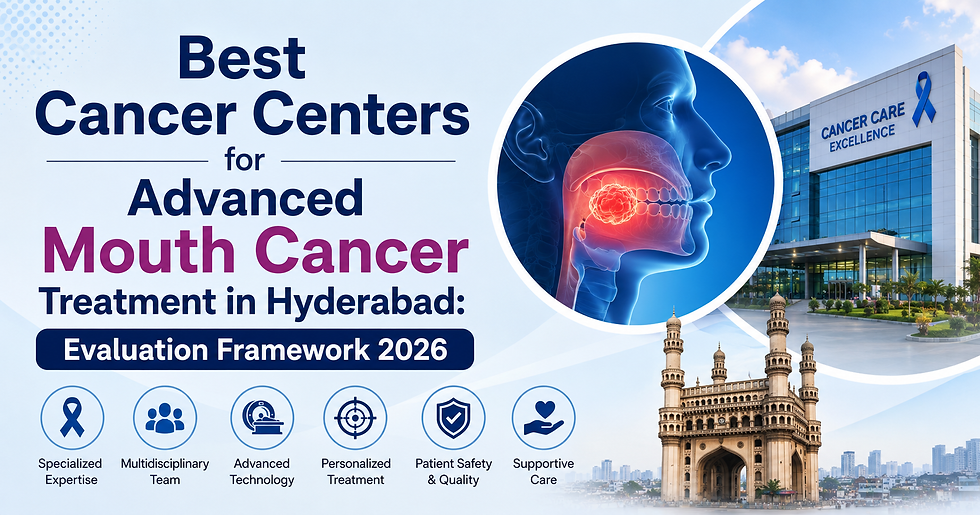
Best Cancer Centers for Advanced Mouth Cancer Treatment in Hyderabad: Evaluation Framework 2026
- Ganesh Akunoori
- May 30
- 11 min read

Advanced mouth cancer treatment requires specialized infrastructure beyond routine oncology care. When evaluating Hyderabad cancer centers, patients face critical decisions about multidisciplinary coordination, reconstruction expertise, and radiation technology.
Key Takeaways
Multidisciplinary tumor boards with weekly case reviews distinguish advanced cancer centers from general oncology facilities
Maxillofacial reconstruction expertise, microvascular free flap surgery and prosthodontic support, determines functional outcomes after complex resections
IMRT and IGRT radiation modalities are available in Hyderabad; proton therapy requires travel to Chennai or international centers
Cost structures vary significantly between government-supported and private hospitals, request itemized written estimates
Clinical trial access becomes critical for recurrent disease and second-line treatment failures
What Makes a Cancer Center 'Advanced' for Mouth Cancer Treatment?
Advanced mouth cancer, stage III/IV disease, recurrent cases, or second-line therapy , demands multidisciplinary team coordination rather than single-specialty care. Hyderabad centers should be evaluated on India-accessible clinical capabilities aligned with ICMR consensus guidelines, not generic international prestige.
Defining Advanced Mouth Cancer: Stage III/IV and Recurrent Disease
Stage III and IV oral cavity cancers involve deep invasion, nodal spread, or distant metastasis. Recurrent disease after prior treatment presents additional resistance patterns. Both scenarios require coordinated systemic therapy, surgery with reconstruction, and precision radiation, delivered by integrated teams, not sequential referrals.
The Multidisciplinary Care Model: Why Single-Specialty Centers Fall Short
Expert teams work with patients on treatment plans that coordinate surgical oncologists, medical oncologists, radiation specialists, and maxillofacial reconstructive surgeons. Indian clinical practice guidelines emphasize integrated decision-making at diagnosis through multidisciplinary tumor boards, siloed doctor visits delay treatment initiation and fragment care pathways.
Top 5 Decision Criteria Checklist
Verify these capabilities at any center:
Multidisciplinary tumor board presence, confirm regular case review meetings involving surgical, medical, and radiation oncologists
Maxillofacial reconstruction expertise, key for quality of life after extensive resections
Radiation modality options, IMRT, image-guided techniques for precision delivery
Clinical trial portfolio, access to investigational therapies for refractory cases
Cost transparency, upfront treatment package pricing to enable informed financial planning
Understanding what 'advanced' means in clinical terms provides the foundation for evaluating specific capabilities that Hyderabad cancer centers should demonstrate.
Clinical Capabilities to Evaluate in Hyderabad Centers
No publicly available source provides a verifiable, center-by-center breakdown of multidisciplinary tumor board composition or meeting frequency in Hyderabad. Patients must ask during consultations for the names of tumor board members, their specialties (surgical oncology, radiation oncology, medical oncology, pathology, radiology), and how often the board convenes to discuss individual cases. Surgery, radiotherapy, and chemoradiotherapy are the main treatment pathways, and coordinated decision-making at a tumor board level is key for advanced mouth cancer.
Verifying Multidisciplinary Tumor Board Composition
Ask for the names and credentials of surgical oncologists, radiation oncologists, medical oncologists, pathologists, and radiologists who participate in tumor board meetings. Request the frequency of meetings, weekly versus monthly, since advanced mouth cancer cases benefit from rapid, coordinated review. Verify that each specialty routinely attends rather than consulting on an ad hoc basis. For further Hyderabad-specific treatment options, see the advanced mouth cancer treatment Hyderabad resource page.
Assessing Surgical Volume and Named Specialist Experience
A visible senior surgeon with documented oral cancer case counts matters more than generic hospital prestige. PACE Hospitals lists Dr. Ramesh Parimi with 35+ years of surgical oncology experience, while Hills Gastro & Onco Care highlights Dr. M.S.S. Keerthi with more than 13,000+ oral cancer patients treated. CION Cancer Clinics reports treating 1,000+ oral cancer cases every year. Ask prospective centers for the names of surgeons who will perform your procedure, their subspecialty training in head and neck oncology, and their annual case volume for mouth cancer specifically.
Radiation Oncology Capabilities: IMRT, IGRT, and Proton Therapy
Standard advanced care combines surgery, conventional radiation, and chemotherapy. Cutting-edge systemic options include intensity-modulated radiotherapy (IMRT) and image-guided radiotherapy (IGRT), which shape radiation beams to spare healthy tissue. Yashoda Hospitals advertises MR Linac radiotherapy with real-time MR visualization, but infrastructure alone does not prove oral-cancer-specific expertise. Verify which radiation modalities the center uses for mouth cancer cases, whether your care team includes a radiation oncologist who specializes in head and neck tumors, and whether integrated palliative care and supportive care services are available to maintain quality of life during treatment.
The most critical capability for complex oral cavity cases is coordinated multidisciplinary decision-making through tumor boards.
Multidisciplinary Tumor Board Presence and Coordination
What a Functional Tumor Board Looks Like
A functional tumor board for advanced oral cancer comprises a core team, surgical oncologist, radiation oncologist, medical oncologist, pathologist, and radiologist, meeting weekly to review cases [3]. The 2025 Indian consensus guidelines establish multidisciplinary coordination as the standard for oral cavity cancer management, recognizing that surgery, radiotherapy, and chemoradiotherapy pathways require integrated specialist input.
Questions to Ask During Your First Consultation
Verify tumor board quality by requesting specific details:
Who are the named members of your oral cancer tumor board?
What specialties are represented?
How often does the tumor board meet?
Will my case be presented at the tumor board?
How will I receive the tumor board's treatment recommendation?
Pi Cancer Care provides 48-hour tumor board review, meeting the coordination standard established in the comparative framework.
Red Flags: When 'Multidisciplinary' Is Just Marketing
Hyderabad centers often claim 'thorough care' or 'multidisciplinary team' in marketing materials without disclosing tumor board composition or meeting frequency on their websites. No publicly available source provides transparent tumor board meeting data for local centers, request this information directly during consultations to distinguish structured clinical coordination from branding.
Tumor board coordination means little without surgical teams capable of managing the reconstruction challenges that advanced resections create.
Surgical Reconstruction and Maxillofacial Expertise
Microvascular Free Flap Vs Local Flap Surgery
Advanced mouth cancer resection often creates large oral cavity defects requiring immediate reconstruction. Two main approaches exist: microvascular free flap surgery (radial forearm flap, fibula flap) uses tissue from distant donor sites with microsurgical blood vessel reconnection, offering superior functional outcomes for complex defects. Local flap reconstruction (pectoralis major flap) repositions nearby tissue and is faster but may compromise speech and swallowing function. Microvascular flaps demand centers with plastic/reconstructive surgery expertise and operating room infrastructure capable of 6 to 12 hour procedures, a capability that distinguishes thorough cancer centers from those offering only oncologic resection.
Prosthetic Rehabilitation and Speech Therapy Coordination
Post-surgical recovery depends on integrated care: maxillofacial prosthodontists design custom obturators and dental prosthetics to restore oral function, while speech pathologists address articulation and swallowing deficits. Pi Cancer Care coordinates maxillofacial reconstruction and prosthetic rehabilitation as part of its integrated post-surgical framework. The anti-pattern: centers offering oncologic resection without in-house reconstruction expertise refer patients externally, fragmenting care and delaying recovery. For thorough coverage of surgical and non-surgical modalities, see latest mouth cancer treatment options.
Typical Reconstruction Surgery Wait Times in Hyderabad
Private centers typically schedule complex flap surgeries within 1 to 2 weeks; government-supported centers may have 3 to 6 week wait times depending on operating room availability and surgical team scheduling. Confirm wait times during initial consultation to plan treatment timelines effectively.
Radiation technology choices directly impact treatment precision and toxicity profiles for head and neck cancers.
Radiation Oncology Modalities: IMRT, IGRT, and Proton Therapy Access
IMRT Vs Conventional Radiation for Oral Cavity Cancer
Intensity-modulated radiation therapy (IMRT) shapes radiation beams to the tumor's contour, reducing dose to salivary glands and mandible compared to conventional 2D or 3D conformal external beam radiation. This precision lowers the risk of xerostomia (dry mouth) and osteoradionecrosis in advanced oral cavity cancer patients. Pi Cancer Care offers radiation oncology as part of its multidisciplinary approach. Patients should verify the linear accelerator model and imaging integration during consultations, as transparent disclosure of specific modalities varies across Hyderabad centers.
IGRT and Real-Time Imaging During Treatment
Image-guided radiation therapy (IGRT) uses real-time imaging (CT, cone-beam CT) to ensure accurate targeting for head and neck cancers, compensating for daily patient positioning variations and tumor motion. IGRT is critical for advanced mouth cancer when tumors are close to critical structures. The table below compares modality availability across three Hyderabad centers.
Center | IMRT / IGRT Availability | PET-CT Diagnostic Imaging | Robotic / Minimally Invasive Surgery |
Pi Cancer Care | Radiation oncology offered; verify equipment specifics | PET-CT support available | Not publicly disclosed |
Apollo Cancer Centres, Hyderabad | Frequently considered for advanced radiation oncology | Available | Available |
Yashoda Hospitals, Hyderabad | Not publicly disclosed | Available | Available |
Proton Therapy: Availability and Cost in India
Proton therapy is not currently available in Hyderabad. Patients considering proton therapy would need to travel to Apollo Proton Cancer Centre in Chennai or international centers, incurring significant cost and logistical implications including visa processing, airfare, and accommodation for patient and caregiver.
For patients with recurrent disease or treatment-resistant cases, clinical trial pathways become key evaluation criteria.
How to Verify Clinical Trial Availability for Advanced Cases
When to Consider Clinical Trial Enrollment
Clinical trials become most relevant for patients with recurrent disease, second-line treatment failure, or eligibility for novel immunotherapy protocols such as checkpoint inhibitors like pembrolizumab for PD-L1 positive tumors. Treatment sequencing, upfront surgery versus induction chemotherapy, remains an active research question, highlighting the importance of discussing trial participation with your care team during initial consultations.
How to Ask About a Center's Trial Portfolio
Direct evidence on clinical trial access pathways at Hyderabad centers is limited. When consulting with centers, ask: (1) Does your center have active clinical trials for advanced oral cancer? (2) What are the eligibility criteria? (3) Do you support referrals to external trial centers if I am not eligible for your trials? These questions ensure you understand both on-site and networked trial access.
Second-Opinion Coordination Pathways
Pi Cancer Care by Dr.Bharat Patodiya provides second-opinion coordination and personalized treatment protocol development, facilitating clinical trial eligibility discussions as part of multidisciplinary tumor boards. This service illustrates one pathway patients can use to access trial centers and investigational treatment options when their primary center does not have matching protocols.
Understanding the financial framework, cost structures, insurance coordination, and transparency practices, helps patients make practical decisions.
Cost Transparency and Insurance Coordination Support
Government-Supported Vs Private Center Pricing Models
Hyderabad's mouth cancer treatment landscape divides into government-supported centers and private hospitals with distinct cost structures. Basavatarakam Indo American Cancer Hospital, a government-supported facility, offers subsidized treatment for patients meeting income eligibility criteria, typically reducing out-of-pocket expenses by 40-60% compared to private hospitals. Private centers like Medicover Hospitals charge higher upfront fees but may provide faster appointment access and bundled cashless insurance coordination. Complete treatment at government centers typically ranges ₹2.5-8 lakhs, while private facilities span ₹8-25 lakhs depending on surgery complexity, radiation cycles, and chemotherapy regimens. Payment plan structures and EMI options vary; government centers rarely offer installment plans, whereas private hospitals may partner with medical financing platforms.
Insurance Cashless Coverage Vs Reimbursement Pathways
Cashless treatment means you pay zero upfront, the hospital bills your insurance company directly, available only when the center is in your insurer's network. Reimbursement models require you to pay all treatment costs upfront, then submit claims to your insurance for partial or full recovery, adding 30-90 days to cash-flow recovery. Verify whether your chosen center offers cashless coordination before beginning treatment; government-supported centers rarely maintain private insurance network agreements, while private hospitals typically hold cashless tie-ups with 5-15 major insurers. Pi Cancer Care's by Dr.Bharat Patodiya patient advocates provide insurance coordination for international coverage, helping navigate both cashless and reimbursement pathways for domestic and cross-border patients.
What to Request in a Written Cost Estimate
Request a written cost estimate itemizing surgery fees (including anesthesia and ICU charges), radiation therapy session counts with per-session pricing, chemotherapy cycle costs (drug + administration), reconstruction surgery if mandibular or maxillary resection is planned, follow-up visit frequency for the first year, and diagnostic imaging (PET-CT, MRI) bundled or billed separately. Pi Cancer Care by Dr.Bharat Patodiya provides transparent pre-treatment cost estimates breaking down each component with specific inclusions and exclusions. For thorough Hyderabad-specific treatment and cost information, see the advanced stage mouth cancer treatment Hyderabad resource page.
Armed with clinical and financial evaluation criteria, patients should enter first consultations with structured questions to compare centers systematically.
Questions to Ask During Your First Consultation
Walking into your first consultation with a structured question list helps you compare centers systematically and gather evidence for an informed decision. Mayo Clinic's guidance on preparing for cancer consultations[4] emphasizes that patients should come ready to ask about treatment options, side effects, and follow-up care. The 10 questions below map directly to the evaluation criteria established in sections 1-7, this is the practical application of the framework for patients walking into a Hyderabad cancer center consultation.
Who are the named members of your oral cancer tumor board and what specialties do they represent?
How often does the tumor board meet and will my case be presented?
What is your surgical oncologist's experience level and annual case volume for advanced mouth cancer?
Do you offer microvascular free flap reconstruction in-house or refer externally?
Which radiation modalities are available (IMRT, IGRT, conventional)?
Do you have active clinical trials for advanced oral cancer and what are the eligibility criteria?
Can you provide a written cost estimate itemizing surgery, radiation sessions, chemotherapy cycles, and follow-up?
Is your center in my insurance network for cashless treatment?
What is the typical wait time for scheduling complex reconstruction surgery?
How do you coordinate second-opinion consultations if I want to explore other centers?
Making Your Decision
Government-supported centers like Basavatarakam offer subsidized treatment for eligible patients but may have longer wait times for complex reconstruction surgery; private hospitals provide faster scheduling but at higher upfront costs, prioritize based on insurance coverage and urgency. Large multi-specialty hospitals like Apollo and Yashoda offer broad oncology infrastructure and multiple radiation modalities, but centers with dedicated head and neck oncology programs (and named senior surgeons with high oral cancer case volumes) may provide more disease-specific expertise, verify tumor board composition and surgeon experience during consultations.
As immunotherapy protocols and novel targeted therapies continue to evolve for advanced oral cavity cancer, access to clinical trial enrollment and second-opinion coordination pathways will become increasingly important evaluation criteria for Hyderabad cancer centers.
Schedule a consultation with Pi Cancer Care by Dr.Bharat Patodiya to discuss personalized treatment protocols and tumor board coordination for advanced mouth cancer.
Frequently Asked Questions
What is the difference between stage III and stage IV mouth cancer?
Stage III mouth cancer involves tumors larger than 4 cm or a single lymph node measuring ≤3 cm, while stage IV disease includes tumors invading adjacent structures (bone, skin, deep muscles) or distant metastasis [2]. The staging framework guides treatment intensity and surgical planning, with advanced stages requiring multidisciplinary coordination for complex resection and reconstruction.
How often should I expect follow-up visits after completing mouth cancer treatment?
Follow-up visits typically occur every 1 to 3 months during the first two years post-treatment, then every 3 to 6 months until the five-year mark [1]. Visit frequency depends on disease stage, treatment modality, and individual risk factors. Request a written follow-up schedule during your treatment planning consultation to clarify imaging intervals and specialist appointments.
What is a multidisciplinary tumor board and why does it matter for advanced mouth cancer?
A multidisciplinary tumor board is a weekly meeting where surgical oncologists, radiation oncologists, medical oncologists, pathologists, and radiologists review complex cases together to develop coordinated treatment plans [3]. For advanced oral cancer requiring surgery, radiotherapy, and systemic therapy, tumor board coordination ensures treatment sequencing aligns with evidence-based protocols rather than siloed specialty decisions.
How much does advanced mouth cancer treatment cost in Hyderabad?
Government-supported centers like Basavatarakam offer subsidized treatment for eligible patients, while private hospital costs vary widely depending on treatment complexity. Request itemized written estimates from each center covering surgery fees, radiation session counts with per-session pricing, chemotherapy cycles, reconstruction procedures, and follow-up visit frequency to compare total cost structures accurately.
Is proton therapy available for mouth cancer in Hyderabad?
Proton therapy is not currently available in Hyderabad. Patients considering proton therapy would need to travel to Apollo Proton Cancer Centre in Chennai or international centers. IMRT and IGRT are the advanced radiation modalities available in Hyderabad and are appropriate for most advanced mouth cancer cases, offering beam shaping and real-time targeting capabilities.
What is the difference between microvascular free flap and local flap reconstruction?
Microvascular free flap reconstruction transfers tissue from distant sites (radial forearm, fibula) with microsurgical vessel reconnection, offering superior functional and cosmetic outcomes for large oral cavity defects. Local flap reconstruction uses adjacent tissue like pectoralis major muscle, requiring shorter operating time but providing less tissue volume and functional restoration. The choice depends on defect size and surgical team expertise.
How do I know if I am eligible for a clinical trial for advanced mouth cancer?
Clinical trial eligibility criteria vary by protocol but typically include disease stage, prior treatment history, performance status, and biomarker status such as PD-L1 expression for immunotherapy trials. Ask centers directly during consultations: Does your center have active clinical trials for advanced oral cancer? What are the eligibility criteria? Do you support referrals to external trial centers?


Comments